The classic, and still the most definitive text on the subject is 'Swarming Its Control and Prevention' by L. E. Snelgrove.

Snelgrove's recommended approach to swarm prevention involves keeping lots of space in the brood box for the queen to lay. Once queen cells are observed, his strategy involves separating the flying bees from the house bees. To achieve this separation, he designed what is now called the Snelgrove board, a simple yet clever piece of equipment that allows you to divide bees within the same hive.

The result of using a Snelgrove board is basically an artificial swarm or split, however, his approach allows for a little more flexibility, particularly if increases are not desired and you plan on recombining the split later. On the downside, you do need to spend a little time opening and closing entrances a few different times over the course of a number of days. If you don't want to bother with Snelgrove's particular technique you will still benefit from reading his book as it is provides a comprehensive look at honeybee reproduction behaviour, and how beekeeper interventions can alter their behaviour.

Queen cells
Queen cells on a new foundationless comb. Via flickr

In addition to his own method, the 112 page book also provides the authors opinion on the pros and cons of other swarm control approaches.

Caution. Those tempted to avert swarming by the destruction of queen cells should pay special attention to the comments on pg. 57 of Snelgrove's book. He observed that after queen cells are destroyed one may find new capped queen cells as soon as four days later since the bees may use existing young worker larvae to replace the damaged cells.

This blog post on swarm prevention by Michael Bush is another quick and simple explanation of the behaviour leading up to a swarm and what you can do to prevent swarming.

Essentially, Mr.Bush is also all about keeping the brood box open and giving the bees enough space up to the point where you see queen cells. You need to keep an eye out for backfilling. This means checking if the size of the brood nest is diminishing as a result of the colony filling cells where brood has emerged with nectar. As an example, the following photo shows a large section of nectar in the middle of a brood frame
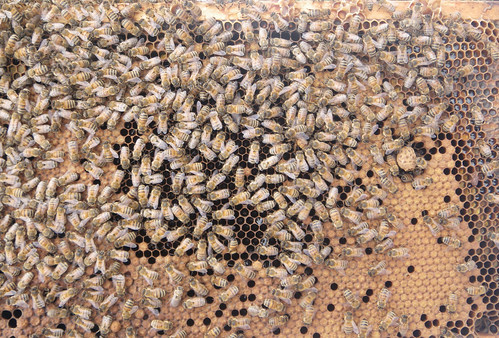
backfilling the broodnest

Keep in mind that you may see a similar behaviour during an intense flow. The bees may initially store nectar quickly in any available cell. They will then move it up above the brood shortly afterwards. So some nectar near brood isn't necessarily anything to worry about, but If they don't move it upwards, then you should expect queen cells are coming.

Tips. You may also want to consider if there's anything you can do to help the bees cure the nectar into honey faster (As moisture is evaporated from nectar it requires less storage space). Many will tell you to increase upper ventilation during a flow, while a few might tell you otherwise.

If the bees are backfilling during the reproductive swarm period, it is suggested to create space in the brood nest itself. Simply adding honey supers may not be enough as the bees may need more brood space rather than honey space.

Once you see queen cells or eggs in queen cups, decide if they are swarm rather than supercedure cells. As I keep hives in urban areas where a swarm can be particularly unwelcome by neighbours, I tend to error on the side of caution and always assume it's a swarm cell.
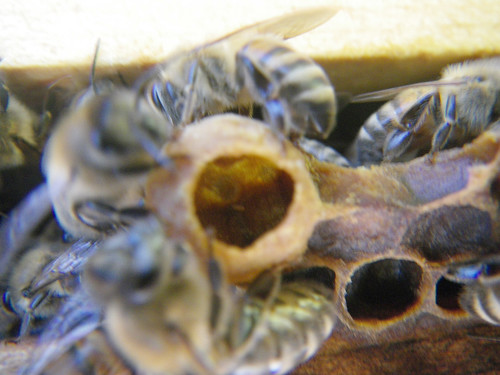
Egg in a queen cup

Caution. Once swarm cells are laid in, splitting, or artificial swarming, is the most effective recourse remaining to prevent a swarm. At this point it becomes extremely difficult to change the plans made by your colony by simply destroying cells and adding more space. The older the age of the developing queen the harder it will be to change the colonie's mind.

Here's a video of a Michael Bush giving a lecture on the subject:

Link

James Fearnley on Propolis

James has been interested in natural medicine since the 70's and started a company focusing on propolis in the 90's. Having comissioned scientific research on the substance and written a booking looking into all the research on the topic it's evident it's a topic he's passionate about.

James talks about the purpose and uses of propolis in this episode on the Barefoot beekeeper podcast:

If you prefer video, much of the same ideas are also touched upon in this lengthy lecture:

Link

Keeping the Bees: Why All Bees Are at Risk and What We Can Do to Save Them by Laurence Packer

In his book Laurence Packer provides a good overview of the complexity of the challenges all types of bees are currently facing, what this problem means for humans, and how we can help. The book is also intermixed with some fascinating tales from a life of chasing after bees around the world. Well worth the read.

A lecture on the different types of wild bees:

Here's a brief overview by Laurence on creating pollinator friendly backyards:

Link

Talk on commercial beekeeping, top bar, small cell, raising hardy northern queens and going treatment free.

Excellent lecture from Sam Comfort covering his past with the commercial beekeeping industry and why he started keeping top bar hives.

Link

Summer honey in Quebec bee country

Cool story on Anicet Desrochers, North Americas largest producer of organic honey. They talk about different types of honey and honey culture.

A few years ago he was heavily featured in the full length documentary titled The Ailing Queen that follows a few different beekeepers through a season:

Miel d'anicet has it's own youtube channel and If you speak french there are online here and one from the CBC  that look at Anicet and his beekeeping:


This quick follow up to my previous post on water sources will take a look at what we've been observing in the bee yard the last few weeks.

honey bee rain barrel drinking systemPhoto by: Shawn Caza / CC: Attribution-NonCommercial-ShareAlike License

We've set up a rain barrel designed to let a trickle of water zig-zag across a wooden board into a bucket.

This year has been fairly dry, so although we add water to the barrel during each visit, the board is usually dry and the bucket has water with dead bees floating in it by our next visit. This was the case a few weeks ago, when we also noticed a large number of bees showing a preference for damp soil of a near by ditch to what we had tried to offer them.

So we decided to try filling the bucket with straw to make it more accessible. On our most recent visit, the ditch was dry and the bees were flocking to the straw filled bucket en masse.

As there were few dead bodies to be seen, I'd say it appears to be a fairly simple and effective option. The above videos also left me with the sense that the straw might be less messy than mud and speculate that it could also be saving them grooming time between sips of water.

3

A few years ago Dave Barr introduced me to the concept of Growing degree days(GDD), a calculation of accumulated heat that helps you to predict the blossoming of plants and trees with pretty good accuracy. It's no subsititute for physically looking around you and taking note of what is in bloom, but following the GDD might help predict the timing of flows and corresponding seasonal bee behaviour.

See wikipedia for a detailed explanation on how the calculation is made and flowering time of various plants.

Use this calculator to check the GDD for your area. All GDD references are given using base 10 throughout the rest of this post.

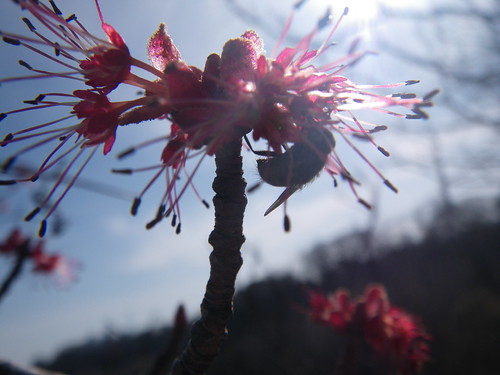
The spring has been excessively warm this year in Toronto. We jumped up to 25 C GDD in the last week. The average for this time of year is 0 C GDD and in 2010, which seemed like a warm early spring at the time, we were only at 3.5 C GDD. Normally this might be a bit early for silver/freeman maples, but just as you would expect from our current GDD, they are just finishing their bloom

freeman maple and native bee

and the native collettes have emerged in time to profit from them and mate:

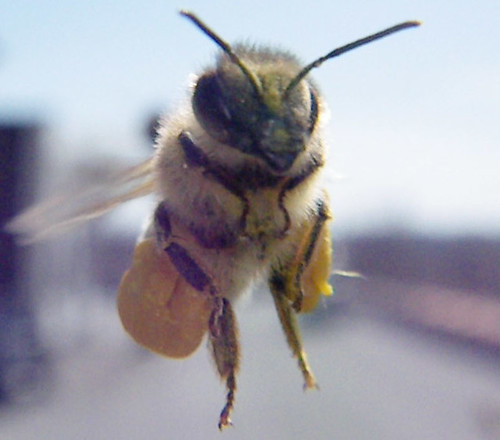
What I have noticed over the past few years is that bees will start returning to the hive with full pollen baskets as the growing degree days rise just above 0 C.

full pollen basket on honey bee

One of the more detailed theories on bee behaviour in early spring I've been able to find is on Michael Bush's site. It attempts to relate certain changes in hive behaviour to bloom times. You may be in a different region than Michael, and things may progress at an unusual rate this year, but I think it will be interesting to keep an eye out for any of the correlations he mentions in the next month or two.

ex:

- If the brood nest starts contracting before the peak of the apple blossoms - they may be switching from buildup to swarm preparation. Look for backfilling, or patches of nectar surrounded by brood like in the photo below.

backfilling the broodnest

- When the Black locust blooms (140 C-160 C GDD) should be the start of the main flow and the interest in initiating a swarming should be reduced.

- Established colonies start making white wax shortly afterwards.

My hypothesis is, that for here in Ontario, around 70-100 C GDD might be a good time to look for the first signs of swarming preperation, with Queen eggs most likely appearing around 115-160 C GDD. However, I imagine with the large amount of stores the bees still have after what was a mild winter, they could run out of space even before this.

Update 2012: Short mild winter, I saw the first queen egg in one of my hives at 64.5 GDD. You can get a quick peek of it behind the bees:

The first swarm in my area was a few days later at 65.5 GDD or about three weeks after the dandelions first bloom, two weeks after the apples and at about the time the lilac trees were in bloom.

forsythia swarm

2013: I observed eggs and larvae in queen cups at 88.5 GDD. A little under a week after the apple blooms, two weeks after the dandelions and about the time the lillacs bloomed, but it's possible they were supercedure cells. It was a cool and wet spring, and I'm not sure there was very many reproductive swarms. I did find a feral colony that had moved in sometime before 95 GDD, but the first report of an actual swarm in the area did not come till around 265 GDD.

2014: Very, very cold winter, with a long cool spring. First report of a queen cell came from a friend around 50 GDD at the time the apple bloom started and two weeks after the dandelions. The first swarm report I heard reported came four weeks later at 252 GDD, about a week after the black locust bloom.

Link

The Biology and Managment of colonies in Winter

This excellent document from the Canadian Association of Professional Apiculturalists provides a quick and clear overview of honey bee behaviour over the winter months including changes in the hive correlated to specific temperatures.

The graph of colony metabolic rate seems particularly useful for estimating honey consumption over the cool months

After hearing a variety of ideas on how this years mild winter might have affected the bees it was nice to find some quantitative data on the subject.

It also offers some thoughts on dealing with moisture in the hive and comparisons of solar versus insulated hive wraps for winter.

Bees collect water for a variety of reasons. Its use in keeping the hive cool during hot summer days was rather intuitive to me. One spring I watched them visit a near by marsh in great numbers:

Why was water such a popular commodity during this cool time of year? It's thought that honey bees use water to help dilute thick honey stores in the spring as well as to aid in flushing out metabolic waste, and raising brood requires a certain amount of humidity.

The above video would suggest the algae both provided a good safe landing pad for the bees and held a good amount of moisture for the bees to drink from.

I also noticed other bees sucking up moisture from the mulch of a recently irrigated tree nursery:

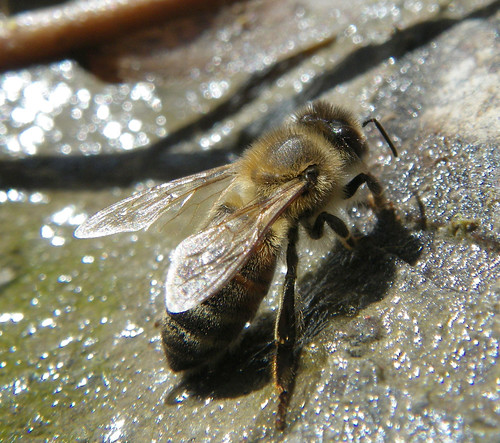
Other bees did well on wet rocks:

bee on rock

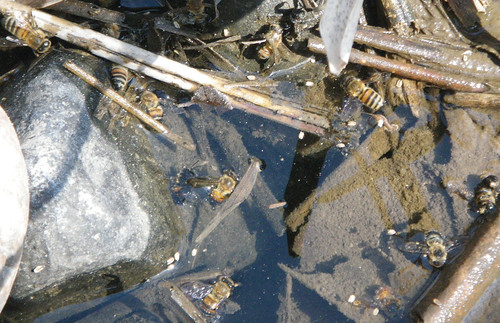
But elsewhere the bees seemed to have had a fair bit of trouble:

drowning bees

These drownings may have been due to less stable terrain around the deeper water, miscalulating a landing, wind or even a result of dealing with other antagonistic insects:

It's no wonder beekeepers often take the trouble to try make their bees a specialized drinking spot.

If you'd prefer your bees to use one source of water over another, a consideration particularly relevant to urban beekeepers who might operate near public pools, be sure to get them used to your source from the start of the season. It's thought to be difficult to stop bees from visiting a water source once they have gotten used to it.

For an unusual approach to keeping moisture in the hive in dry climates, check out the insightful experiment of providing water within the hive outlined here by Dennis Murrell of Bee Natural.