A study performed southern tip of Gotland,an island in the Baltic sea where 150 colonies were left unmanaged with varroa mites. After 6 years it appeared that a host-parasite co-adaptation occured with the 5 colonies, plus an addition to 8 swarm colonies that remained.
Original discovery of feral bees co-existing with varroa
A 2007 study by Seeley looking at the honeybee population of the feral bee population of the Arnot Forest showed a stable host - parasite relationship with the varroa mite.
An interesting part of this paper is that it describes how survivor bees co-existing with varroa were taken out of the Arnot forest and inoculated with mites from another apiary. As mite growth in inoculated colonies occurred at a level consistent with control colonies, we might guess less virulent mites have evolved in the unmanaged bee population of the Arnot forest.
Genetic analysis of the Arnot forest survivor bees
In 2015 Alexander S. Mikheyev, Mandy M.Y. Tin, Jatin Arora & Thomas D. Seeley published a study showing that the mite resistant bees living in the Arnot forest are genetically distinct from the bees in the nearby apiaries. They also compared genes of current bees with museum sample of Arnot forest bees from the 1970's. This comparison shows there was likely a genetic bottle neck, and Arnot forest bees have evolved distinct traits as compared to the bees living in the forest prior to varroa. It also suggests that some influx of some amount of new genetics has occurred in the population, including those associated with africanized bees.
This book considers the issue of moisture within the hive. The author gives particular attention to the effects of ventilation on curing honey and how it could contribute to swarming behaviour.
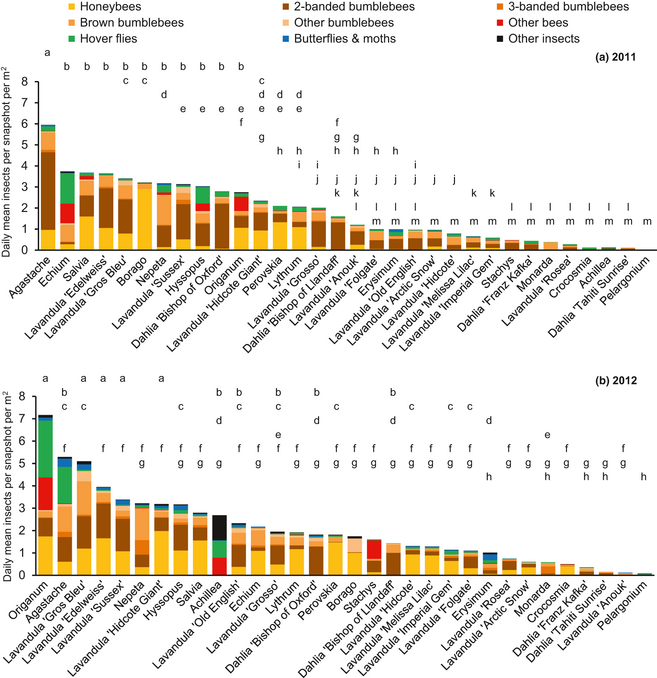
There's lots of lists of flowers to plant to help the bees out there, but this is the first time I've seen a scientific comparison of the attractiveness of different plants.
Figure 3 from the paper seems to offer a quick glimpse at which types of flowers were the favourites.
I've been interested in agastache (anise hyssop), since reading praise for it in beekeeping literature a few years ago and because it's native to North America. This gives me a little extra incentive to try planting a little more of it.
I sent Mihail a question and he was quick to remind me that this study was only conducted in one area and results may vary in different regions. So you may want to take this research as inspiration to try setting up a test garden near your own bees and see how your results compare.
Feeding, particularly at the end of season when there could be a lack of natural forage can set off robbing behaviour. For this reason it's best to feed on the top of the hive and just a little before sunset.
This year I added either empty hive boxes or ekes on top of the hives to make space for a plastic food container that is fitted with a wooden raft. The inspiration for which comes from this page which outlines a few different feeder setups.
This is what it looks like in action:
Apart from robbing behaviour, the other reason for which it is preferred to feed bees at the end of the day is that it makes the hive go absolutely nuts. It seems that once a few bees discover this sudden source of sweetness they go tell their friends. Naturally other bees will want in on the action and set off to look for this great source of forage. It should not be unexpected that they will look for food outside of the hive, that is, after all, where they usually look for nectar sources. Very quickly orientation flights will commence and the bees will scour the immediate area for the food source which is actually inside their hive.
You can see in the above video that they will also be attracted to the smallest gaps around the feeder even if they are not big enough for them to get through.
I personally feel it's best to avoid feeding all together if you can, however if you must feed, then feeding small amounts in the late evening is best. This is a particularly pertinent consideration for urban beekeepers. Though the mass amounts of bees searching the area for non-existent flowers may not act aggressively towards people, it is one of the situations where your neighbours are more likely to come into contact with your bees. In one case, when I returned 24 hours after feeding, they still had some syrup left in the feeder and they were still sending out foragers to find flowers. Upon arrival at the apiary, while I was still 75 meters away and two stories down from the hives, I already had a few bees buzzing around me.
The following video of the hive entrance starts right after the colony had been given feed. Each five second clip shows what the entrance looked like at one minute intervals. So by the end of the video you see what was happening roughly 18 minutes after feeding.
One of the first things you are likely to see when setting up a new hive are forager bees on orientation flights. Bees hovering in front of and circling around are learning the landmarks of the new location. An important step in ensuring they will be able to find their home again after searching for flowers. In the following video we see the activity around the hive after being placed in a new location. You can see a stark contrast in the flight patterns around the hive in the first few days as compared with the last day:
You will also see this behaviour in hives that are already established at a location as younger bees develop into foragers and leave the hive for the first time, typically, this behaviour will not be as pronounced as when moving a hive.
It is possible to confuse robbing with orientation flights. If the bees are young and fuzzy and they are peacefully entering and exiting the hive it is most likely orientation flights.
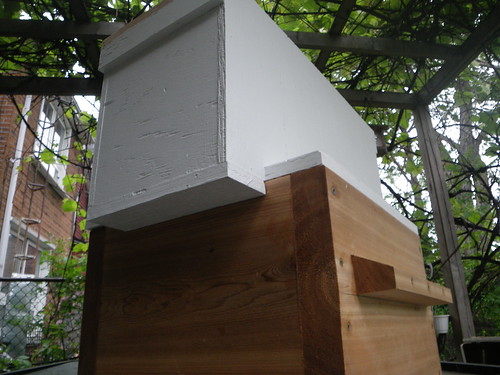
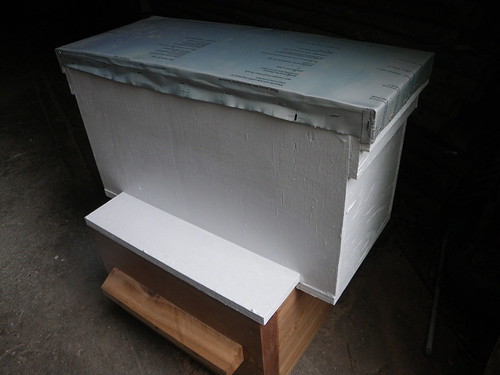
I used inspiration from the colony transfer section of this page and the simple D. Coates nuc box plan as the basis for my lang to warré transitioning nuc box. I need to put this box on top of a warré box so I reduced the height of the walls a 1/2 inch to compensate for the height of the floor that I am removing from the D. Coates design. The only other modification to the base of the design was to omit an entrance in this box. Instead, the warré box will sit on a regular bottom board entrance.
I did add a floor just to the section that hangs over the side of the warré in the back and front. I also glued and nailed 'wings' to the side of the nuc which extend to the edge of the warré box. The wings serve as a roof for the section of the warré the nuc does not cover.
The wings are slightly asymmetrical, this was done in order to position the nuc box on top of the warré such that the gaps between the langstroth frames will line up with gaps of the warré frames. The hope is that this will make it easier for the bees to move between the two boxes.
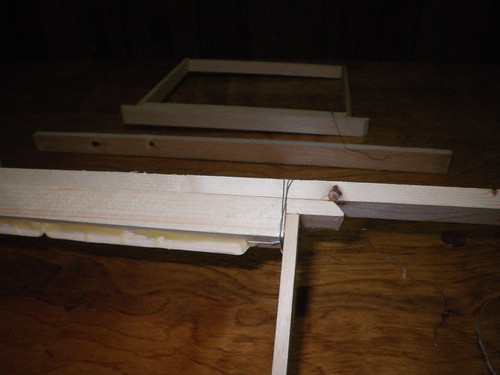
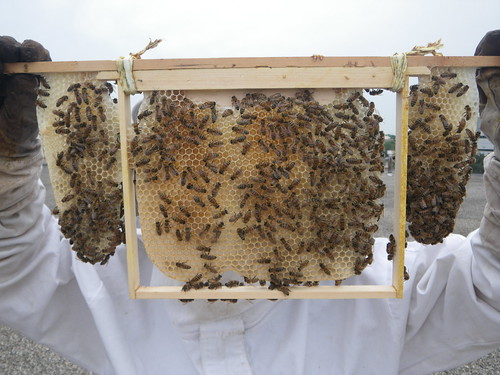
I made a five frame nuc box, but around my area they typically sell four frame nucs. So, in addition to the frames I receive from the bee breeder, I will place one of my smaller warré frames in the nuc box. To do this I simply used wire from twist ties to strap a frame to a wooden slat that fits the length of the langstroth. Once the bees start drawing out this frame I will be able to remove the wooden slat and place the frame in the box below to encourage them to move down.
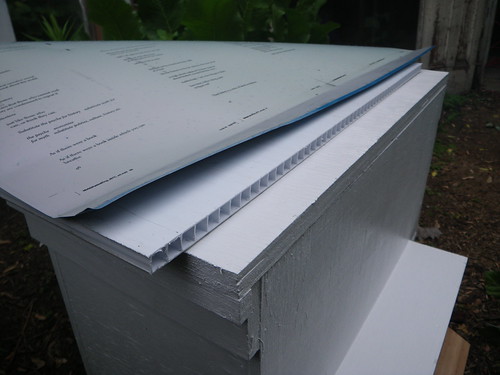
On top of the plywood roof I added an old printing press plate that I sourced from a local publisher and a discarded plastic corflute sign board (similar to that used for election signs). The sign board has air pockets and will hopefully slow the heat from the sun on the metal from conducting through the roof. The printing press plates are simple to work with. I cut it to size with regular scissors and staple it in place with an ordinary staple gun.
The plywood was scrap from neighbourhood carpenters, and the paint came from the municipal household hazardous waste dump, thus the cost of making this box was virtually nothing.
I'll be eager to get the nuc off the hive and give them a proper roof, but am confident this box should make for a smooth and simple transition between the different shaped hives.
Update: I've now successfully encouraged bees to move down with this method.
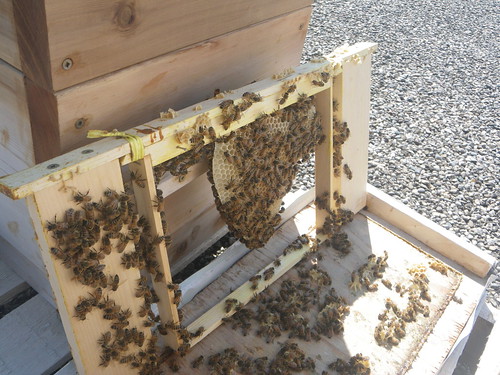
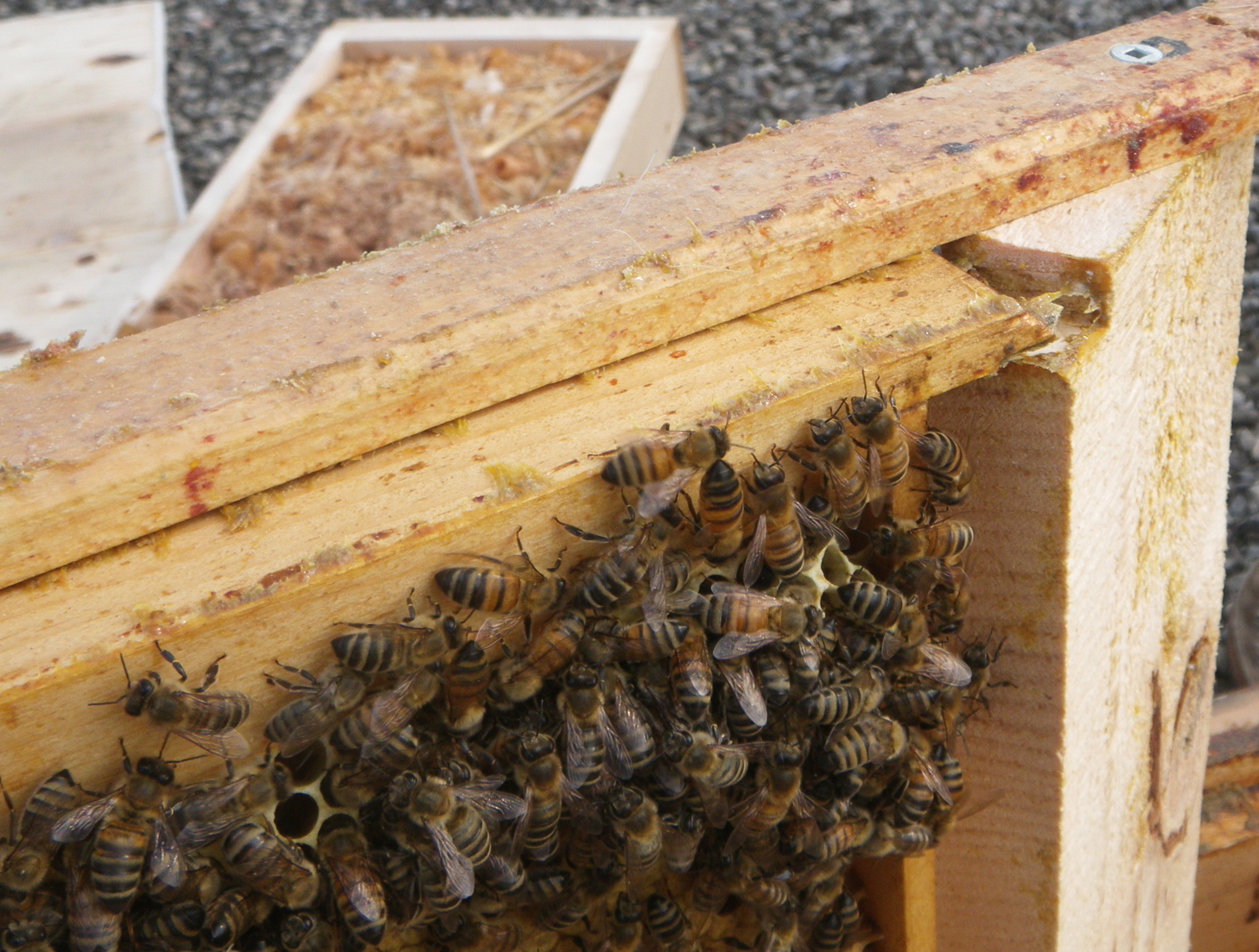
You can see the nuc transition box in practice here. The main issue I had was that they built comb on the side of my frames that would need to be broken off. In subsequent attempts I used a wooden block to prevent this.
2015 update: While the wooden blocks were a significant improvement they would still build little combs between the frame and the blocks and it was cumbersome to untie the frame. So I made the blocks with only a 'bee space' between it and the frame and a little notch at the top of the block acts as a frame rest:
My current approach is to try to move frames down, and place new frames back in the nuc as long as they are raising brood in the nuc. As comb building is prioritized at the top of the hive, and I already have drawn combs up here, I found it to be a good way to keep getting straight combs. I stop adding new combs once I no longer have a brood frames in the nuc box as they bees like to make honey combs bulge out into any available open space.
New Jersey based beekeeper Kevin Inglin puts out shows that go into detail on different managment techniques, provides updates on what's going on in his own apiary, and other pertinent bee news.
It's often stated that swarm cells are on the bottom of the frame and supersedure cells are built in the middle of the comb. This may not always be the case.
Emergency Queen Cells
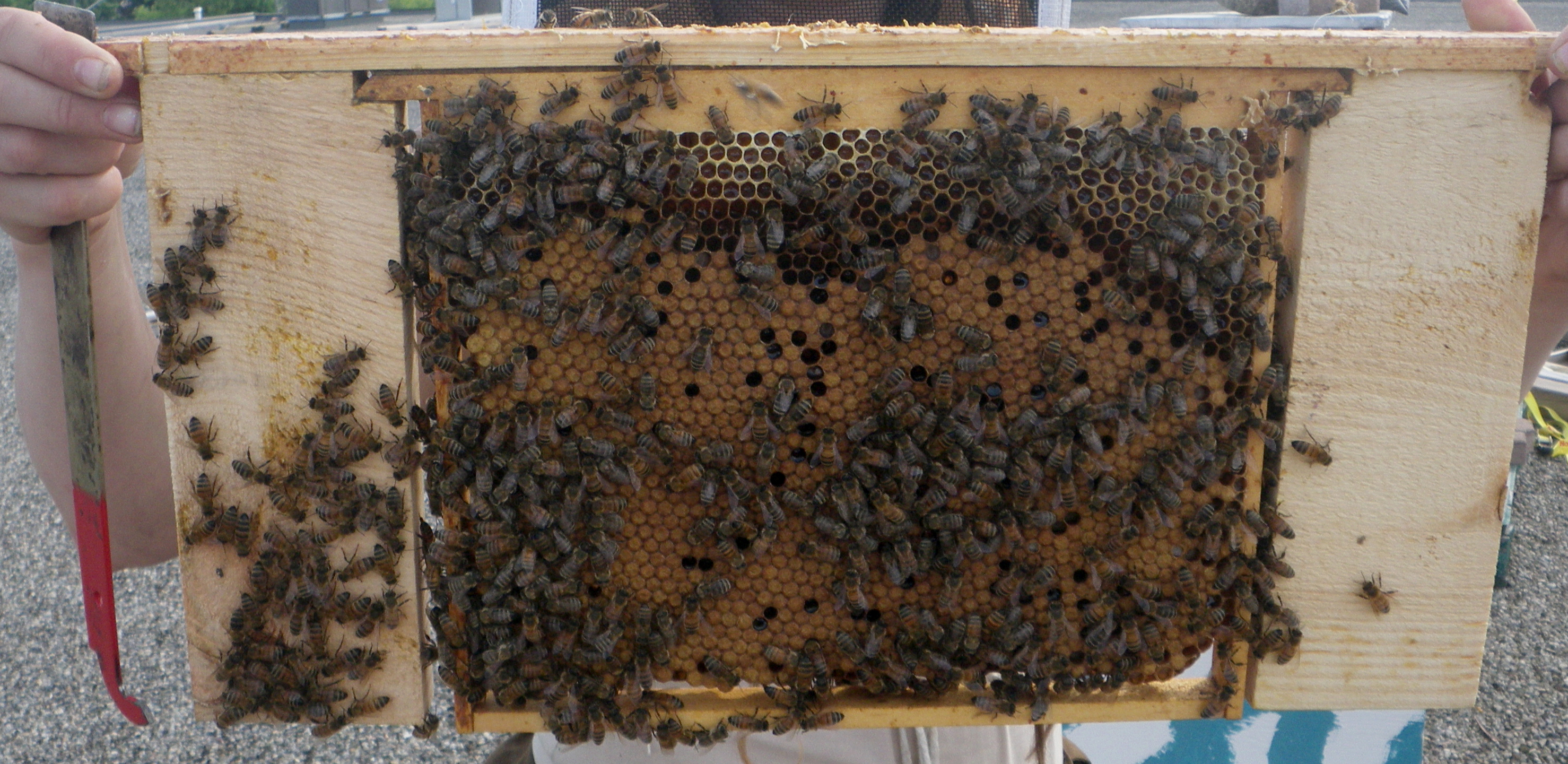
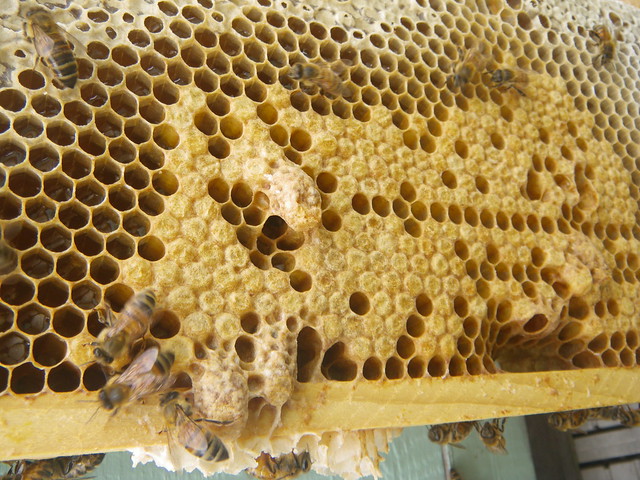
Certainly, if a hive feels they are queenless they may try to make an emergency queen from eggs laid in regular worker comb. Emergency queen cells are structurally different than swarm or supercedure cells. You should be able to tell that the cell was made as an extension of a regular worker brood cell. We can see few examples of emergency cells in this photo:
Queen Cells Used During Supercedure and Swarming Look Identical
But a hive will often have proper queen cups ready at the bottom or middle of frames which may be used for either supersedure or swarming. So, rather than the appearance or location of the cell, one must think about the wider context of the hive to figure out what the bees are trying to do.
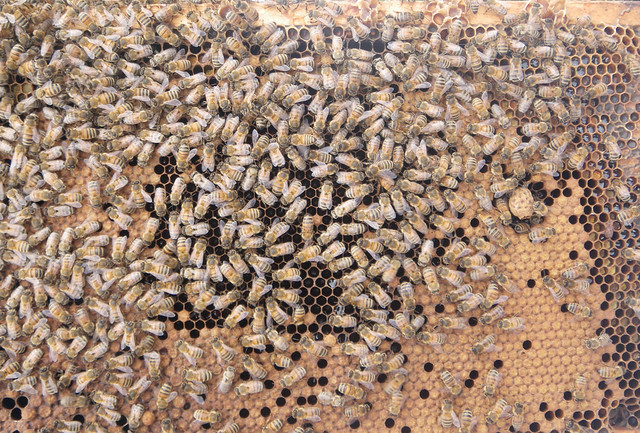
For example, the following picture shows a frame with a good number of bees, a queen cup with an egg on the comb near the middle-right of the frame, and the brood nest in the process of being back-filled with nectar.
In the case above we are looking at a strong hive building up and things are getting congested between a queen that is laying well and increasing honey stores. It's best to assume the bees want to swarm. By the way, did you spot the current queen in the above photo? Click here for a closer look.
Other Beekeepers That Have Dispelled This Myth
Walt Wright has also suggested a larger quantity of queen cups/cells or queens in a wide variety of stages of development, with the first queen laid at the periphery and subsequent queens laid across the brood nest, is indicative of swarming. Whereas a supersedure tends to be just a few queens all laid at about the same time on the periphery of the brood nest.
The myths about supersedure cells run so deep in beekeeping literature that you still may not be convinced after having read both my post and the preceding link, so I will also offer you this link to David Cushman's perspective on the topic.
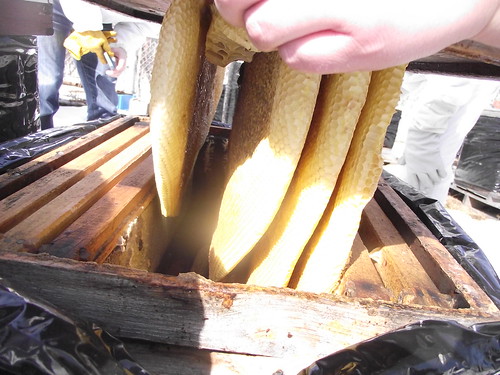
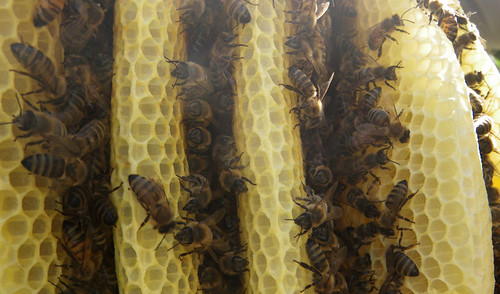
Last year a unique situation occured that allowed us to verify the comb spacing and cell size claims made in regards to naturally built comb.
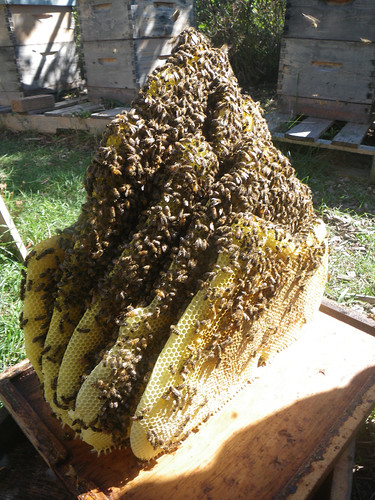
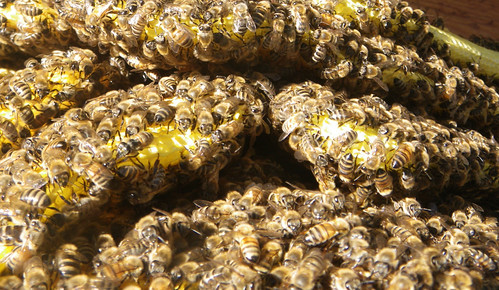
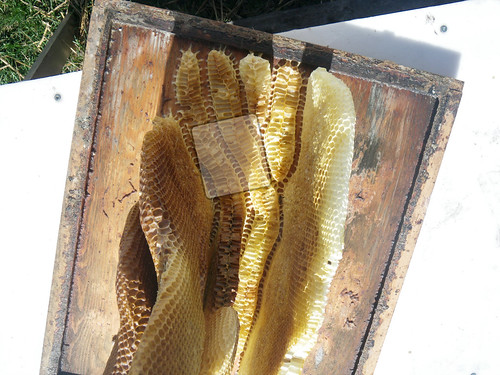
We hived a swarm while short on frames, by the time we returned it had prolifically built a few large combs extending into a second brood box. We added frames to the sides but left the wild combs on the inner cover all season.
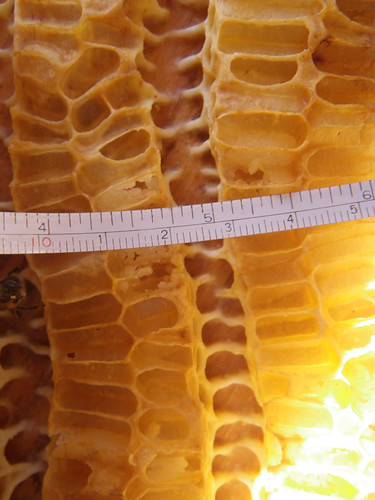
The comb spacing on the Hoffman frames typically used in the langstroth hive is about 35mm (1 3/8") and the cell size of standard foundation we use is 5.4mm.
A quick glance at this hive was enough to make me feel the bees had decided on a much tighter spacing in some areas of their comb than our frames provide.
Unfortunately, the hive didn't make it through the winter, but this did give me the opportunity to measure a comb design little influenced by top bars, frames, starter strips or foundation.
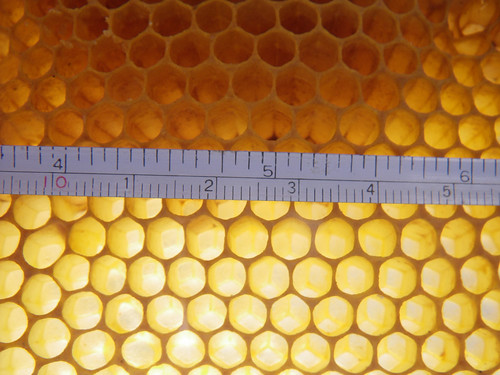
First I measured the comb spacing. The above photo shows the distance from one comb's mid-rib to the next comb's mid-rib to be approximately 31mm. With the space between combs somewhere between 7-8mm.
The portion of the comb measured in the photo above is indicated by the white square in the following photo:
With cell size it is often suggested to measure ten cells across and average the result, as bees tend to build cells of variable sizes. The following was measured in the lower-mid section of brood comb.
I've heard many claim that bees coming from a hive with standard foundation will build 5.1mm cells in their next generation of combs. This experience seems to confirm that.
It is of course important to remember that comb spacing varies according to use. With honey and drone combs being wider than brood combs. The spacing used in a standard langstroth hive is really an attempt at averaging out the differences. I've been contemplating what frame spacing to use all winter while building hives for next season. Though I've seen the langstroth spacing work well enough, I'm tempted to see what advantage may come from using a variable spacing. It's become popular in the top bar community, where one can not rely on foundation for straight comb, to use 32mm (1 1/4") for the brood nest and 38mm (1 1/2") for honey combs. There is a great deal of speculation about the advantages of small cell bees and a corresponding tighter comb space. For me, the fact that bees seem to want to build cells and comb at various sizes when given the chance, seems like reason enough to set up the hive in such a way as to make this possible. Wish me luck.