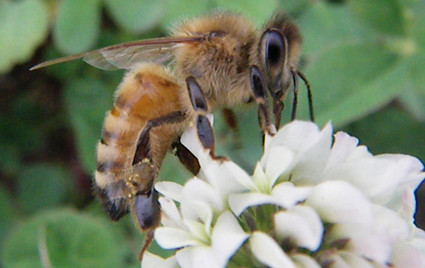
New research suggest personality differences between individual bees in a hive. The scientists looked for a pre-disposition to novelty seeking by looking at which bees took on scout jobs. They found certain bees 3.4 times more likely to take on these jobs and linked this behaviour to the same genes that regulate novelty seeking in vertabrates.
The original paper is here, but you need a subscription to 'Science' access it.
As my SO is a fudge lover, making her a batch for valentines day was an obvious gift. The only thing about fudge that i'm not crazy about is all the sugar that goes into it. So I set out to make a fudge using honey.
3/4 C crystallized honey from our hives (any raw honey will do, but crystalized probably gets the final texture a little more solid quicker)
The chocolate I used was 65% cacao and already had some sweetener and coconut butter added. So I ended up using much less honey and butter in proportion to chocolate than the original recipe called for. As a sweet fiend I think it's still good and sweet and I probably would have cut back on the honey regardless.
Method
The chocolate came in bar form so the first step was to turn it into a powder in the food processor. Then I mixed all the ingredients together in a large bowl. I used a hand blender to achieve a smooth finely mixed consistency. The result was a very soft fudge that was very easy to mold and a taste I'm totally in love with.
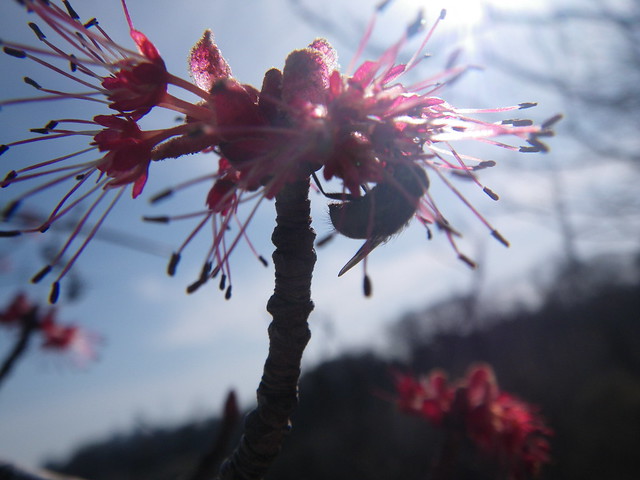
Early spring 2011 I walked right past the nesting grounds of what I now believe could be cellophane bees or colletes inaequalis. They were flying very rapidly around some loose sandy soil on a steep forest slope, so without taking a good look I just assumed they were flies.
It was only when I looked at the blooms of the freeman maple standing at the top of the slope that I realized what was happening.
As the first trees had started to bloom the entire hill side had suddenly sprung to life and I felt lucky that this marvel had not completely slipped past my attention.
These bees are also known as mining bees. They are solitary bees which live in individual ground burrows, but many of these bees will set up home right along side each other.
As an city-boy the draw to beekeeping was simple. I was generally concerned about the environmental impact of industrial agriculture, and the quality of my food supply. As a result I wanted to become more involved in the production of my own food. While working at a community garden I learned there was a group doing beekeeping.
At the time the notion of keeping bees seemed like a wild dream. I do love honey so I decided being able to see how it's made was an opportunity I should jump at. Never mind the fact that I had up to this point been afraid of bees and was uncertain if I was allergic to their stings. I was careful my first season as a beekeeper and didn't get stung at all. I've since learned that I'm not allergic and very few people really are.
Challenges to urban beekeeping in Toronto
The greatest impediment to keeping bees in this city is the Ontario bee act. Though many cities around the world have recently opened up the doors to beekeepers, our provincial law specifies that hives must be kept at a distance of 30m from property lines (or 10m from highways). Though the act isn't enforced unless someone complains about your bees, it makes me reluctant to keep a hive at my own house and drives others to practice beekeeping covertly without the benefit of the provincial inspector.
On the other hand there certainly seems to be wide spread interest in beekeeping, and many different parties are competing for locations. Without the 30m rule, we'd likely need some form of regulations around hive density or we'd see an over abundance of bees in the city similar to what has been reported in New York and London.
So far both the local media and the public have been very receptive to the concept of urban bees. So I can't exactly say public relations is a problem, but it is certainly something I think about a great deal. Many Toronto beekeepers are just jumping in and hoping to figure things out as they go. The problem is, even among those who've been doing this for a while, it's a very small minority that have a reasonable sense of what is involved in managing population growth. This has resulted in some overcrowded apiaries, lots of swarms getting away from beekeepers, and feral colonies setting up homes in places where they are not wanted and need to be removed.
So far not a big deal, but I fear as our cities bee population grows we might see a backlash similar to what New York experienced after a few swarms clustered on busy public streets. With this in mind, I've put in a great deal of effort towards mastering the art of population control and have established relationships with farms where I can bring bees if my city locations exceed capacity.
I'd also say some work still needs to be done increasing the general public's comfort level around bees, showing that these generally docile creatures are not a serious threat and that they differ from wasps.
Why not move to a farm if you want to keep bees?
Well, there is a great deal I enjoy about the urban lifestyle, but I probably would move to a farm if I saw it as a good opportunity for me. It's just very difficult to see myself becoming a full time beekeeper at this time. It's a profession that is facing some monumental challenges and it would make for a very risky career move.
There might be a great deal of concrete here but there is also a great diversity of flowers. In contrast, much of our agricultural land has been transformed into large mono-crop operations that depend on the heavy use of pesticides which consequently makes it uninhabitable for bees.
Where do city bees find flowers?
The quality of forage varies widely by neighbourhood, a few well planted gardens here, a street lined with a bunch of the right kind of trees there, an empty lot over grown with wild flowers before being developed does add up.
On the other hand, with some locations we've seen our hives consistently under-produce, and have had to accept that there was simply not enough forage in the area for the number of hives that had been set up in the area.
Beekeeping groups and associations
Resonating Bodies - "A series of art and community projects which focus on pollination ecology, with special attention paid to the intersection of native bees, habitat and coevolution of plants and pollinators of Toronto, Canada and beyond"
Urban Toronto Beekeepers' AssociationThey've been meeting once a month since 2013. Meetings typically feature a speaker presenting a topic. They also have a facebook group.
Toronto Beekeepers Co-op - This group has been operating at different sites in Toronto since the early 2000's. A limited number of new members are accepted every year. Members learn the art of beekeeping along side staff beekeepers through the collective management of the hives.
Toronto District Beekeepers’ Association - Membership is open to all. The groups meets once a month throughout the beekeeping season. The group has been around over 100 years and attracts all sorts of beekeepers. The meetings are held just a little outside of Toronto at the Kortright Centre in Vaughan.
U of T B.E.E.S. - The university of Toronto's student beekeeping club at the st.George campus.
Bee supply shops
It's a bit of a niche market, and there's not a whole lot of options out there. If making a long trip it's not a bad idea to call ahead and make sure that they have what you need in stock.
Propolis-etc. (Near Keele and Sheppard) - They also have a few shops around Ontario and Quebec.
As a beekeeper I often have the opportunity to speak to people about why bees are dying or colony collapse disorder (CCD). In response I’ve developed the Honey Bee Murder Mystery Game.
We've put together two versions for different age groups. Choose the one you would like to download here:
- Importance of pollination if not previously discussed or bees and co-operation(it’s a co-operative game).
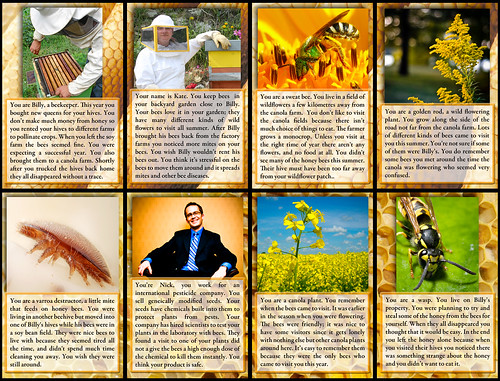
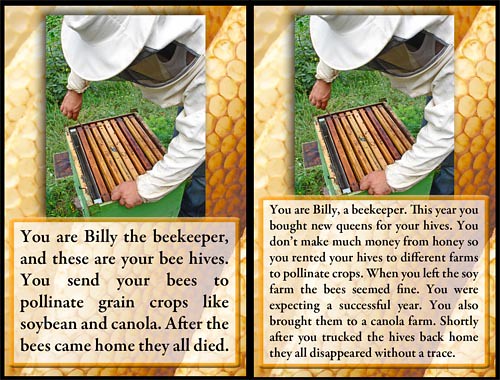
- Explain they are going to play a murder mystery game. A beekeeper named Billy has lost all his bees and that they will each receive a character card. They will take on the role of this character and talk to each other to discover what happened to the bees.
Hand out game cards: 5 minutes
- There are 16 game cards.
- The first page of 8 game cards should be enough to play the game if it is a smaller group.
- If you make two sets of cards, larger groups can be split into teams and compete to solve the mystery first.
- Each person should get one card. Give them a minute or two to get familiar with their character.
Playing the game: 15 minutes
They will then be asked to work as a group, sharing information with each other to try and solve the mystery.
Conclusion: 5 minutes
Have the students explain their conclusions. Let them know it’s a real phenomenon called CCD and discuss any questions the game raises.
Solution
Groups using the full set of characters should be able to identify stress of transportation on bees, pest/diseases, queen genetics and poor nutrition for bees on mono-crop farms, and pesticide use as contributing factors.
To the Toronto Beekeeper’s Co-op for all I’ve learned with them, Dave Barr for writing the simplified version of the text, Melissa Berney for editing the texts, and all the photographers who made their photo’s available for me to use via a Creative Commons license (see game file for details).
4) Game text of kids version - Use this if you would like to translate the game into another language. I will make new graphic game cards from translated text.
The Honey Bee Murder Mystery Game is published under Creative Commons BY-NC-SA 3.0. You are free to copy and distribute this work for non-commercial purposes as long as you attribute it to: Shawn Caza of http://www.beekeeping.isgood.ca
Worried for the health of their bees as well as loosing their honey(a court recently ruled that a German beekeepers honey was unfit for human consumption because it contained traces of GMO corn) French beekeepers invaded a Monsanto location demanding an end to GMO crops.
There is a short video of this event in french here.
The following is my translation of a french article about the beekeepers protest at Monsato in France:
Friday a hundred beekeepers occupied the site of American argo-chemical giant Monsanto in Monbéqui for several hours to demand that the government quickly ban GMO corn in France.
The protesters left after the government re-affirmed their commitment to ban growing Monsanto 810.
This ban has been in question since the end of November when the state council had cancelled the suspension of growing GMO corn, a suspension imposed by the government in February 2008.
“The government is committed at the highest level to maintaining the ban on growing Monsanto 810, and notably for the next growing season.” the minister of Ecology told the AFP on Friday.
Olivier Belval, the president of the French National Beekeepers Union reported that a representative of the prefect guaranteed the protesters that a safeguard clause assuring the ban of selling and growing this GMO will be made, as promised in November by Nathalie Kosciusko-Morizet the minister of Ecology.
The beekeepers will be received next week by the ministers of Agriculture and Ecology according to Guy Kastler of the Confédération paysanne(Rural Confederation) which was behind this action.
The beekeepers are worried by the risk that their honey will be contaminated by GMO corn and will be declared unsuitable for human consumption according to European policies. They want an immediate government decision, with a decree until the the safeguard clause is put into action.
Some twenty beekeepers huddled in a van were brought onto the site at Monbéqui, where Monsanto carries out corn growing experiments, using the trojan horse technique. They pretended to be a delivery truck, and once admitted the gates were opened to many dozens of others. The beekeepers came from all over the south-west according to journalists of the AFP
Some dressed in white with veils protecting their face brought two hives and smokers into the building before calling the Minister of Ecology by telephone.
“We demand an order banning the sale and growing of Monsanto 810 and a ban of all GMOs that produce nectar or pollen” that could pollute honey, declared Jean Sabench, a beekeeper from Hérault, spokesman for the Confédération paysanne.
Jean Sabench came for the survival of beekeeping, “already in peril”, but also for the survival of the bees, the disappearance of these essential pollinators will have heavy consequences on the environment and agriculture.
The government promised “a new clause that will not be legally attackable” said the minister of Ecology. She said It could be made before the sowing season at the end of February.
The Monsanto site at Monbéqui had been the victim of a reaping operation in 1999 by farmers of the Confédération paysanne.
This occupation is “an unacceptable violation of private property and illegal”, deplored Yann Fichet, directer of institutional affairs for Monsanto-France
According to the French National Beekeepers Union, in 2011 the production of French honey is estimated at around 20 000 tons, similar to that of 2010. But this quantity represents a great decline from 1995 harvests (32 000 tons).
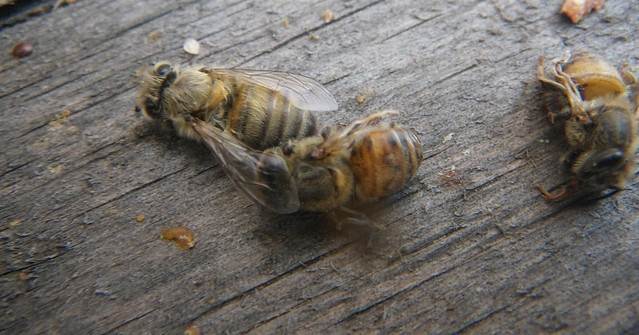
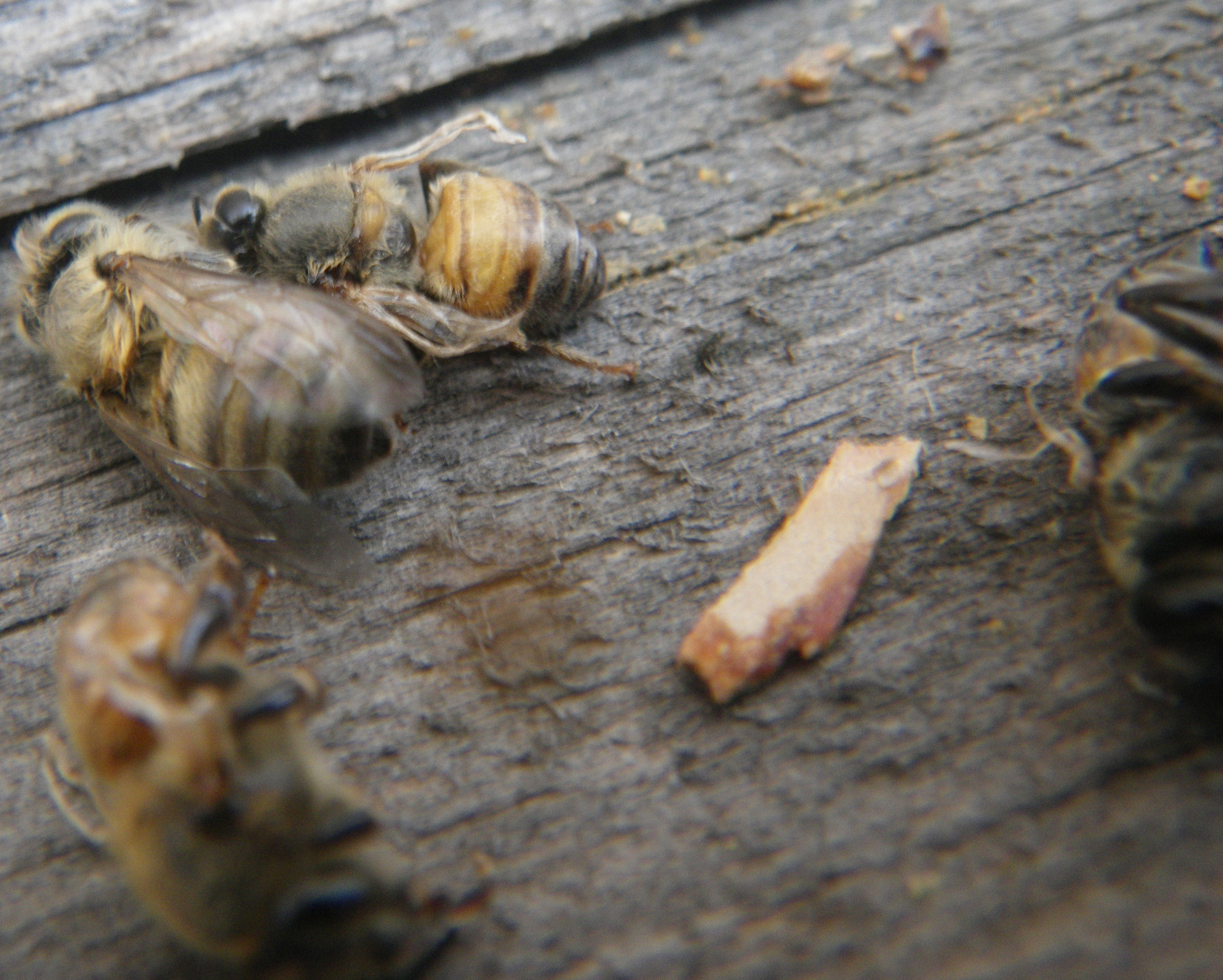
I first noticed bees with deformed wings virus(DWV) crawling around in front of one of our stronger hives in the late summer of last year.
We treated in the fall, and by spring symptoms had dissapeared. It was the strongest of our twenty hives this spring and we had to split it to try and keep it from swarming. By late summer(Sept. 1st) I once again started noticing bees with deformed wings. From this point in the season on, anytime I looked, I was able to find at least one if not a handful of damaged bees crawling around in the area directly in front of this one hive.
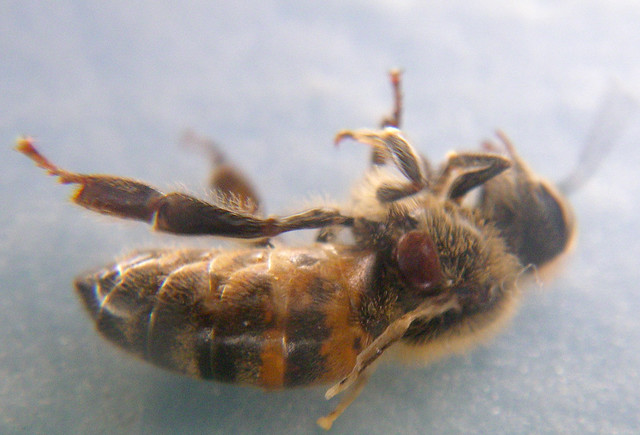
Bees with deformed wings are expelled from the hive and typically have a life span under 48 hours. Seeing large amounts of DWV is a clear indicator a hive is suffering from a serious varroa problem.
Bees with DWV may also have really stubby short abdomens. In some cases I see the short abdomens without necessarily seeing visibly deformed wings. I believe these stubby bees with healthy looking wings, are also incapable of flight.
This graphic novel follows Nyuki through the various life stages of a bee.
The story is written and drawn by bioligist and hits on a wide variety of scientifically based fact in the process of telling the story. Even those who've read a great deal about bees might learn something new here.
Sugar dusting bees is a non-chemical, relatively harmless approach for dealing with varroa mites. The concept is that covering the bees with sugar will make things slippery for the mites and stimulate grooming behaviour in bees.
It's widely accepted that sugar dusting will successfully knock down a portion of the phoretic mites, that is those mites riding on the adult bees, but not those reproducing under capped brood. As such, this approach is most useful to employ during a queenless period after the old queens brood had emerged but before brood from the new queen is capped.
Generally sugar dusting is viewed as just one component of an Integrated pest management system, useful for keeping numbers down, but one shouldn't expect it to function as a magic bullet that will solve all your mite problems.
The effect upon the hive is immediate and obvious. Bees run for cover and once sugared, stop whatever else they were doing and proceed to clean the sugar off. I've typically tried this using about 1 cup of powdered sugar per deep brood box. In my experience, most of the mite drop will happen in the first 15 minutes. This photo is an example of what can be pulled out of the bottom of the hive in 15 minutes.
In the first hour I'm usually able to recover about 1/3 of the sugar from the bottom board. This technique works best in tandem with a screened bottom board, as it knocks off the mites but doesn't kill them. You can slide something like cardboard into the entrance of a solid bottom board when sugar dusting so the mite can be easily removed after the drop.
The main drawback to sugar dusting is that the bees do appear to devote a fair bit of energy cleaning out the sugar. The following video shows a colony actively in clean-up mode after sugar dusting. The video was shot at the end of November, there was little forage available this time of year, as such the hive entrance had been very quite prior to dusting.
Randy Oliver at scientificbeekeeping.com has experimented a fair bit about this form of mite control. His three part series is some of the most useful information I've been able to dig up on the subject. He's found weekly sugar dusting can slow mite reproduction, but it might not knock them back enough by itself. In the end his experiemnts may have raised as many questions as they answered. If nothing else, his experiments suggest that full colony sugar dusting might be one of the best ways of assessing a colonies infestation rate:
"The take-home message is that the results of this series of tests lead me to question the reliability of either natural mite fall or the alcohol wash (or ether roll) as monitors of mite infestation level! It appears to me that a whole-colony mite drop accelerated by sugar dust (or other mite dislodging agent) is likely the most accurate field-practical way to determine a colony’s mite level."